
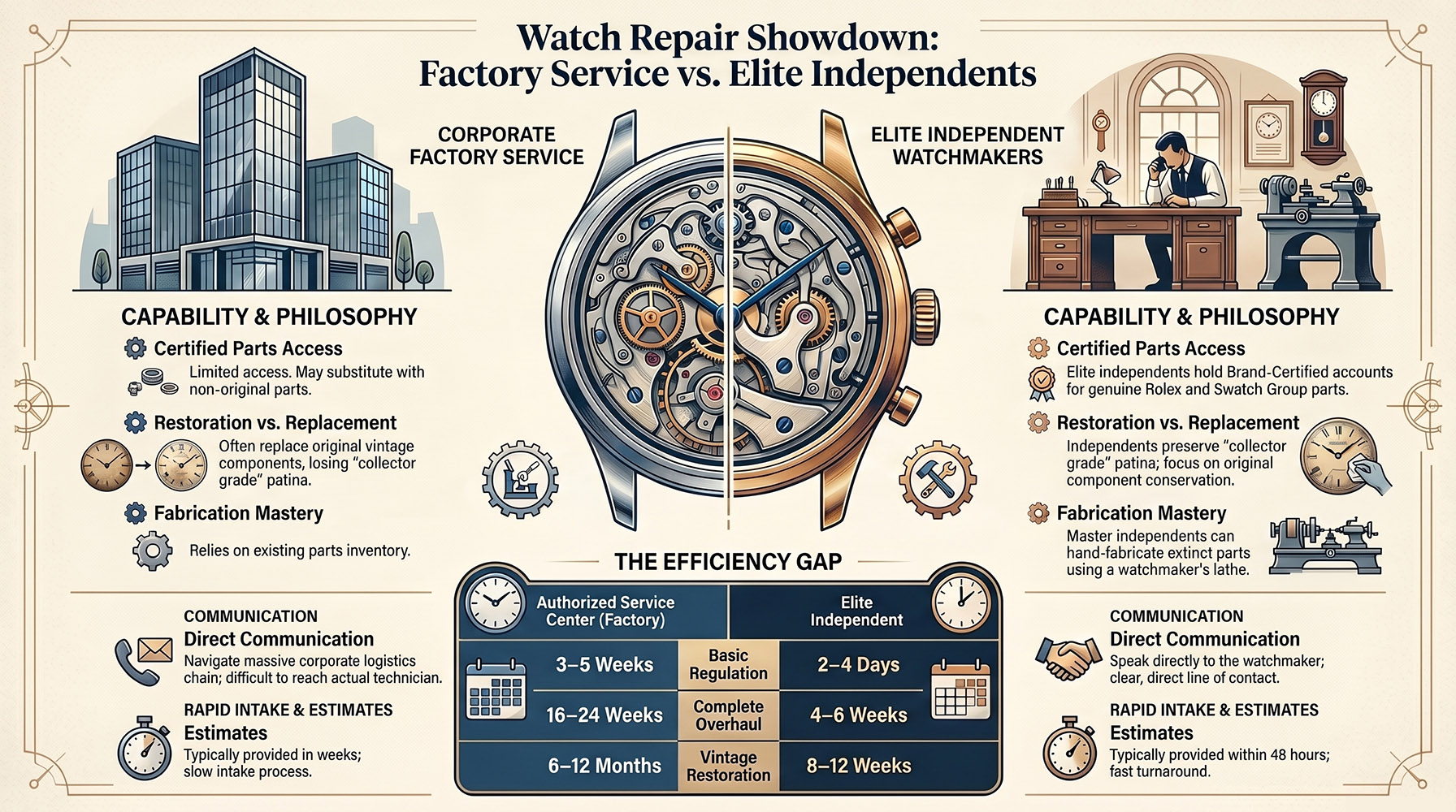
The Repair Showdown: Is the "Factory" Really Your Only Option?
In 2026, the luxury watch industry often pushes a specific narrative: If you don't send your watch to the brand’s headquarters, you won't get genuine parts. For the average consumer, this sounds like a rule. For the professional collector, it’s a myth that needs debunking.
While Authorized Service Centers (ASC) offer a corporate safety net, a top-tier Independent Watchmaker often possesses a "secret arsenal" of parts and skills that the factory simply cannot match—especially when it comes to rare or vintage pieces.
1. The "Parts Account" Advantage
Many people assume independents use "generic" parts. In reality, elite independents hold Brand-Certified Parts Accounts.
-
SAWTA & CW21 Certification: Watchmakers who have earned these credentials have a direct pipeline to manufacturers like Rolex and the Swatch Group. They order the exact same wheels, springs, and crystals used in the factory.
-
The Professional Edge: You get the "factory-correct" repair but with a direct line of communication to the person actually holding the tweezers.
2. The Vintage "Time Capsule" Stash
The factory’s biggest weakness is their "standardization" policy. If you send a 1970s icon to the brand, they may replace your original, aged hands with shiny new ones, destroying the watch’s "patina" and resale value.
-
Independent Hoarding: Master independents have often spent decades buying out the inventories of retired watchmakers. They may own the only "New Old Stock" (NOS) 1960s crown or internal bridge left in existence.
-
Fabrication Mastery: When a part is truly extinct, a master independent uses a watchmaker’s lathe to hand-fabricate components. This is a level of high-end engineering that a standard factory "part-swapper" is rarely trained to do.
When you send a watch to an Authorized Service Center, it doesn't go straight to a watchmaker. It enters a massive corporate logistics chain:
-
Shipping & Intake: 1–2 weeks of processing and "verification."
-
The Estimate Phase: 2–3 weeks just to receive a quote for the work.
-
The Batching System: Factories often wait to process specific calibers in "batches," meaning your watch might sit in a safe for a month before a technician even opens the case.
The Independent Advantage: When you walk into a master independent’s shop, the person you speak to is often the person doing the work. The intake is instant, the estimate is usually provided within 48 hours, and your watch is placed in a much smaller, more manageable queue.
3. The Decision Matrix
| Feature | Authorized Service Center | Elite Independent Specialist |
| Parts Source | Current Factory Production | Direct Accounts + Vintage Stockpiles |
| Philosophy | Replace with "New" | Restore and Preserve "Original" |
| Communication | Customer Service Rep | The Watchmaker Directly |
| Resale Impact | Standardizes Value | Preserves "Collector Grade" Patina |
| Specialty | Modern & Current Models | Rare, Vintage, & Discontinued |
Turnaround Comparison Table
| Service Type | Authorized Service Center | Elite Independent |
| Basic Regulation | 3–5 Weeks | 2–4 Days |
| Complete Overhaul | 16–24 Weeks | 4–6 Weeks |
| Vintage Restoration | 6–12 Months | 8–12 Weeks |
| Water Pressure Test | 2 Weeks | While you wait |
The "Professional Move" is to find a Certified Independent. You get the same genuine parts, the same high-tech pressure testing, and the same mechanical precision—but you get your watch back on your wrist in a fraction of the time.